New Finds


Roast chicken is our favourite Sunday dinner comfort food. I’m always looking for the “perfect” roast chicken, so I recently tried Julia Child’s classic recipe. It’s a little more labour intensive than most recipes, because you must turn the chicken from one side to another to cook and brown it evenly. But the results are well worth it. The chicken is juicy and the skin is brown and crisp. Served with roasted root vegetables, it’s comfort food at its best.

Avoiding Additives and Preservatives

Use butter that contains a single ingredient: cream. If you are making the gravy, use an all natural chicken stock, such as Imagine brand low-sodium broth.

Rub chicken with butter and place in shallow roasting pan

After five minutes, flip the chicken onto its left side

Flip the chicken from side to side to roast and brown it evenly

For the last 15 minutes or so, roast the chicken breast side up

Julia Child's Roast Chicken, served with roasted vegetables

Ingredients:

3-pound whole roasting or frying chicken

¾ teaspoon salt

6 tablespoons softened butter

1 small sliced carrot

1 small sliced onion

1 tablespoon good cooking oil

½ tablespoon minced shallots or ½ tablespoon green onion

1 cup brown chicken stock, canned chicken broth or 1 cup beef bouillon

Salt and pepper

Preparation:

Preheat oven to 425 degrees. Sprinkle the inside of the chicken with ¼ teaspoon salt and smear in half the butter.

Truss the chicken and dry it thoroughly. Rub the skin with the rest of the butter.

In a small saucepan melt 2 tablespoons butter, and add 1 tablespoon cooking oil. Set aside for basting.

Place the chicken, breast up, in a shallow roasting pan. Strew the vegetables around it and set it on the rack in the middle of the preheated oven.

Allow the chicken to brown lightly for 15 minutes, turning it on the left side after 5 minutes, on the right side for the last 5 minutes, and basting it with the butter and oil after each turn. Baste rapidly so the oven does not cool off.

Reduce oven to 350 degrees.

Leave the chicken on its side and baste every 8 to 10 minutes using the fat in the roasting pan when the butter and oil are exhausted.

Halfway through estimated roasting time (about 40 minutes), salt the chicken with ¼ teaspoon of salt and turn it on its other side. Continue basting.

Fifteen minutes before the end of the estimated roasting time, salt again and turn the chicken breast up. Continue basting.

When chicken is done, discard trussing strings and set chicken on hot platter. It should sit at room temperature for 5 to 10 minutes before being carved so the juices are absorbed by the meat.

Chicken is done when it registers between 175 and 190 degrees, depending on preferred doneness.

Remove all but two tablespoons of fat from the pan. Stir in the minced shallot and cook slowly for 1 minute. Add the stock and boil rapidly over high heat, scraping up juices with a wooden spoon and letting it reduce to about ½ cup. Season with salt and pepper. Off heat and just before serving, swirl in the last 1-2 tablespoons butter.  Pour a spoonful over chicken and serve the remainder at the table from a sauceboat. Serves 4.

From Julia Child’s Mastering the Art of French Cooking

Black cod, also known as sablefish, is a cold-water fish that is showing up in many recipes these days because of its white flesh, delicate texture and sweet taste. If you can find it, try it in this recipe. You can also use halibut, which is not as high in fat. The preparation of the fish in this recipe is straightforward; the interesting ingredients are reserved for the Swiss chard. You boil a whole lemon for a half hour until it is tender, then chop the pulp, peel and pith. The chopped lemon is combined with chopped black olives and the mixture is added to the sautéed chard. It’s an unusual flavour mix, but it works very well with the oily fish. This is also a very nutritious, low-fat recipe, with only 220 calories per serving.

Avoiding Additives and Preservatives

The only thing to watch out for in this recipe are the olives. Look for olives cured in oil without any additives or preservatives.

Season black cod or halibut with ground spices

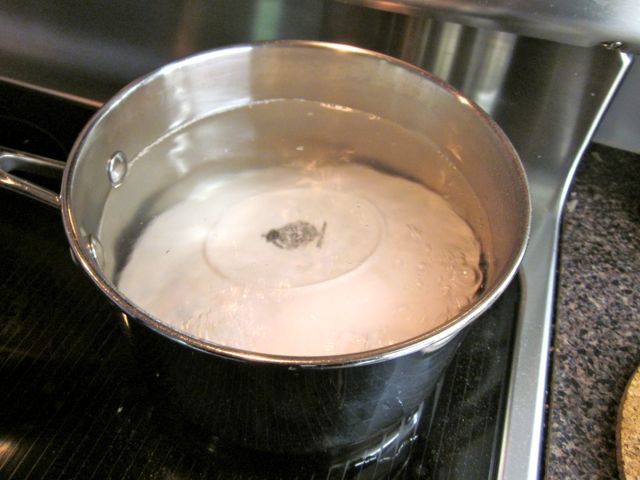
Boil a whole lemon for 30 minutes; a plate on top will keep it submerged

Scoop the flesh out of the boiled lemon

Chop the lemon pulp, skin and pith and combine with chopped black olives

It looks like a lot of Swiss chard

But it quickly reduces to this

Meanwhile, quickly pan fry the fish

Add the lemon-olive mixture to the Swiss chard and serve with the fish

Ingredients:

1 lemon, stem removed

¼ teaspoon coriander seeds

¼ teaspoon cumin seeds

2 tablespoons olive oil, divided

4 4-ounce pieces skin-on black cod fillet

Kosher salt and freshly ground black pepper

1 garlic clove, chopped

¼ teaspoon (or more) crushed red pepper flakes

2 large bunches Swiss chard (about 1 ½ pound total), ribs and stems removed, leaves torn

2 tablespoons oil-cured black olives, pitted, sliced

Preparation:

Place lemon in a small saucepan; add water just to cover. Place a small heatproof plate inside the saucepan, on top of the lemon, to keep it submerged. Bring water to a boil; reduce heat and simmer until lemon is very tender when pierced with a knife, about 30 minutes. Drain. Cut lemon in half (to help cool faster); let cool.

Scoop out pulp from both lemon halves and press pulp through a coarse-mesh sieve into a small bowl; discard solids. Finely chop peel and pith and add to pulp. Set aside.

Toast coriander and cumin seeds in a small skillet over medium heat, stirring often, until slightly darkened and fragrant, about 3 minutes. Set aside.

Coarsely grind coriander and cumin seeds in spice mill or with mortar and pestle. Heat 1 tablespoon oil in a large nonstick skillet over medium-high heat. Season fish with spice mixture, salt, and pepper; place skin side down in skillet. Cook until browned and crisp, 5-6 minutes. Turn; cook until just opaque in the center, 2-4 minutes more.

Meanwhile, heat remaining 1 tablespoon oil in a large skillet over medium heat. Add garlic and ¼ teaspoon crushed red pepper flakes; cook, stirring, until fragrant, about 30 seconds. Add chard by the handful, tossing and allowing it to wilt slightly between additions. Season with salt and pepper. Cook, tossing occasionally, until all chard is tender, 5-7 minutes. Set aside.

Mix olives and reserved lemon mixture into chard. Season with salt, pepper, and more crushed red pepper flakes, if desired. Serve fish with chard. Serves 4.

From the January 2013 issue of Bon Appetit

You can make this pork noodle stir fry from the January 2013 issue of Canadian Living as mild or spicy as you like. Once you start cooking, the stir-fry is done in less than 15 minutes, so be sure to have all your ingredients ready to go before you begin. I whirred a pork tenderloin around in my food processor instead of buying pre-ground pork, and that worked very well. I also sliced my own cabbage, instead of buying coleslaw mix. You could add any vegetables you have on hand to this dish.

Avoiding Additives and Preservatives:

Soy sauce, chili garlic paste, rice vinegar and sesame oil can contain artificial ingredients. Instead of soy sauce, try tamari, which is preserved with alcohol instead of sodium benzoate. I used Tabasco brand hot sauce instead of chili garlic paste. Marukan light seasoned rice vinegar and Eden toasted sesame oil are both additive free.

Soak rice stick in hot water and drain

Assemble all your ingredients before starting to cook

Brown the ground pork

Stir fry the mushrooms and vegetables

Add the noodles and sauce

Spicy Pork Noodle Stir-Fry

Ingredients:

4 oz (113 g) rice stick vermicelli, (about 1/8 inch/3 mm wide)

2 tbsp (30 mL) sodium-reduced soy sauce

2 tsp (10 mL) chili garlic paste, (such as sambal oelek)

1-1/2 tsp (7 mL) seasoned rice vinegar

1 tsp (5 mL) granulated sugar

1 tsp (5 mL) sesame oil

1 pinch salt

8 oz (227 g) lean ground pork

1 tsp (5 mL) vegetable oil

1 cup (250 mL) sliced shiitake mushrooms

1 cup (250 mL) coleslaw mix

½ cup (125 mL) snow peas, trimmed and thinly sliced

2 green onions, thinly sliced

2 cloves garlic, minced

3 tbsp (45 mL) chopped roasted unsalted peanuts

Preparation:

In large bowl, soak vermicelli in warm water until softened and separated, about 5 minutes. Drain and set aside.

Meanwhile, whisk together soy sauce, chili paste, vinegar, sugar, sesame oil, salt and 2/3 cup (150 mL) water; set aside.

In wok or large skillet over medium-high heat, cook pork, stirring occasionally and breaking up with back of wooden spoon, until browned, about 5 minutes. With slotted spoon, remove pork to plate. Drain and set aside.

Wipe wok clean and return to heat. Add vegetable oil and mushrooms; cook, stirring occasionally, until mushrooms begin to soften, about 2 minutes. Add coleslaw mix, snow peas, green onions and garlic; stir-fry for 2 minutes.

Stir in soy sauce mixture and noodles, tossing to combine; stir-fry until tender, about 3 minutes. Sprinkle with peanuts.

From the January 2013 issue of Canadian Living

Now that you’ve had your fill of holiday turkey, ham and prime rib (not to mention time spent in the kitchen) here’s a recipe from Fast Flavours for lamb chops that is ready is about 20 minutes. Sear the chops, and while they are resting, quickly sauté peppers, onions, lemon and mint to create a tasty salsa. I served this with a salad of garlic roasted potatoes and warm spinach.

Avoiding Additives and Preservatives

The only ingredient to be careful of in this recipe is the hot sauce, which can contain preservatives and colour. I use Tabasco brand original hot sauce, which is all-natural.

Sear lamb chops for 4 or 5 minutes per side

Quickly saute peppers and onions with lemon juice and mint

Top the chops with the salsa and serve

Ingredients:

A splash or two of vegetable oil

4 lamb chops, patted dry

2 red bell peppers, seeded and finely diced

1 small red onion, sliced

Zest and juice of 1 lemon

1 cup (250 mL) chopped fresh mint

½ tsp (2 mL) salt

½ tsp (2 mL) hot sauce

Preparation:

Preheat a skillet over medium-high heat. Add enough vegetable oil to cover the bottom of the pan. When the oil is hot, add the lamb chops. Sear the first side until browned and crusty, 4 to 5 minutes. Adjust the heat so that the chops sizzle but don’t smoke.

Flip the chops and sear the other side, adding oil as needed. Remove pan from heat, transfer chops to plate and cover loosely with foil.

Return the pan to the heat and add the peppers and onions. Saute, stirring, until the vegetables soften, 3 to 4 minutes. Add the lemon zest and juice, mint, salt and hot sauce. Saute just enough to heat through, 1 or 2 minutes. Top the chops with the warm salsa and serve. Serves 2.

From Fast Flavours by Chef Michael Smith

I was a little skeptical about the cooking method in this recipe from the December 2012 issue of Bon Appetit. It recommends starting skin-on, bone-in chicken thighs, skin side down, in a room temperature skillet coated with a teaspoon of oil. As the pan heats, the thighs were supposed to slowly render their fat, making the skin crispy. Well, the skin on my chicken thighs stuck to the pan. I don’t eat the skin anyway, so it was not a big problem for me. The thighs also took longer to cook than the recipe calls for—about 10 more minutes in the oven. So why I am posting this recipe? Because the chicken was moist and tender, and the flavour created by the caramelized lemon slices and oregano in the pan sauce was great. If you have better luck with the room temperature skillet method, let me know!

Avoiding Additives and Preservatives

The two things to look out for here are the white wine and the chicken stock. If you are sensitive to sulfites, look for a white wine with fewer than 10 parts per million. I use Imagine brand chicken stock.

Thinly slice lemons

Fresh oregano, shallots and garlic are in the sauce

Start chicken, skin side down, in room temperature pan

Rest the roasted chicken while you make the sauce

The caramelized lemon slices flavour the sauce

Roasted Chicken Thighs with Lemon and Oregano

Ingredients:

1 lemon

4 large or 8 small skin-on, boneless chicken thighs

Kosher salt and freshly ground black pepper

3 teaspoons olive oil, divided

3 sprigs oregano

1 tablespoon minced shallot

½ garlic clove, minced

1/8 teaspoon crushed red pepper flakes

¼ cup dry white wine (such as Sauvignon Blanc)

½ cup low-sodium chicken broth

Preparation:

Preheat oven to 425°. Very thinly slice half of lemon; discard any seeds. Cut remaining lemon half into 2 wedges. Season chicken thighs with salt and pepper.

Coat a large room-temperature skillet with 1 teaspoon oil. Add chicken, skin side down.

Place skillet over medium heat and cook, letting skin render and brown, and pouring off excess fat to maintain a thin coating in pan, until chicken is cooked halfway through, about 10 minutes.

Scatter half of lemon slices over chicken and half on bottom of skillet (the slices on top of the chicken will soften; those in the skillet will caramelize). Transfer skillet to oven, leaving chicken skin side down. Roast until chicken is cooked through, skin is crisp, and lemon slices on bottom of skillet are caramelized, 6-8 minutes.

Transfer chicken pieces, skin side up, and caramelized lemon slices from bottom of skillet to a warm platter. (Leave softened lemon slices in the skillet.) Return skillet to medium heat. Add oregano sprigs, shallot, garlic, and red pepper flakes; cook, stirring frequently, until fragrant, about 1 minute.

Remove skillet from heat. Add wine; cook over medium heat until reduced by half, 1-2 minutes. Add broth; cook until thickened, about 3 minutes. Squeeze 1 lemon wedge over and season sauce with salt, pepper, and juice from remaining lemon wedge, if desired.

Drizzle with 2 teaspoons oil. Return chicken to skillet, skin side up, to rewarm. Serve topped with caramelized lemon slices. Serves 4.

From the December 2012 issue of Bon Appetit

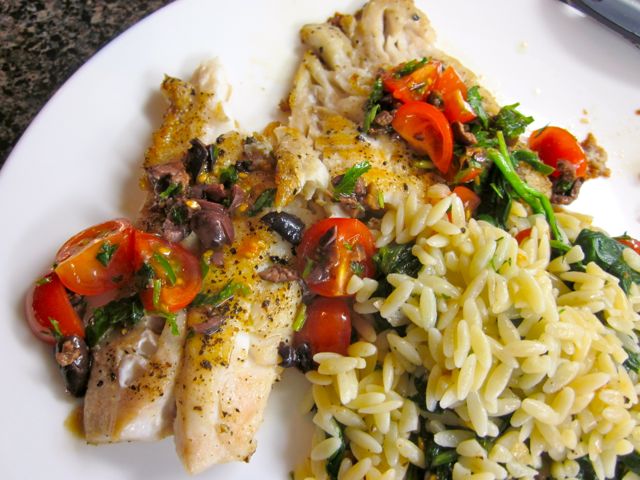
This is an easy recipe that yields great results in very little time. Thin fish fillets are quickly pan-fried and topped with a savoury salsa of olives, tomatoes and parsley. The fish is served with a side dish of orzo mixed with garlic, baby spinach, cherry tomatoes, dill and lemon juice. The recipe calls for tilapia, but snapper, trout, sole, orange roughy or perch would all work well.

Avoiding Additives and Preservatives

The ingredients in this recipe that could contain additives and preservatives include the butter and olives. Look for a butter that contains only cream, with no colour, and for olives with no preservatives added. I am currently using PC black label Niçoise olives. Be sure to use freshly squeezed lemon juice, as concentrates are bitter and contain preservatives such as sodium benzoate.

Fish fillets are quickly pan fried

Mix cooked orzo with spinach and cherry tomatoes

Fish with olive salsa and spinach orzo

Ingredients:

1 tbsp (15 mL) butter

2 tilapia fillets, (about 1 lb/450 g total), halved lengthwise

1 pinch salt

1 pinch pepper

Olive Salsa

1/4 cup (60 mL) cherry tomatoes, diced

2 tbsp (30 mL) finely chopped Kalamata olives

1 tbsp (15 mL) finely chopped fresh parsley

1 tsp (5 mL) olive oil

Spinach Orzo

1 cup (250 mL) orzo

2 tsp (10 mL) olive oil

3 cloves garlic, minced

8 cups (2 L) baby spinach

1 cup (250 mL) cherry tomatoes, quartered

2 tbsp (30 mL) chopped fresh dill

2 tbsp (30 mL) lemon juice

1/4 tsp (1 mL) salt

1/4 tsp (1 mL) pepper

Preparation:

Olive Salsa: In small bowl, combine tomatoes with olives, parsley and oil.

Spinach Orzo: In saucepan of boiling salted water, cook orzo according to package directions; drain and set aside.

In nonstick skillet, heat oil over medium heat; cook garlic, stirring, until softened, about 1 minute. Add spinach; cook, stirring, until wilted, about 3 minutes. Stir into orzo. Stir in tomatoes, dill, lemon juice, salt and pepper. Set aside.

Meanwhile, in nonstick skillet, melt butter over medium heat. Sprinkle tilapia with salt and pepper; cook until fish flakes easily with fork, about 3 minutes per side.

Top fish with salsa; serve with orzo. Serves 4.

From the December 2012 Canadian Living

At this time of year, fast and easy recipes for hors d-oeuvres come in handy. This recipe for marinated olives from the November 1994 issue of Bon Appetit is both those things, and it’s also better made a few days before serving. I put out a bowl of these before a girls’ night dinner last week to celebrate the November birthdays of my friends Lesley and Diane. Lesley asked me to post the recipe, so here it is!

Avoiding Additives and Preservatives

It can be difficult to find olives with no preservatives, but it is possible. If you are buying them from an olive bar, ask to see the ingredient label. I have been able to find all-natural black and green olives, made by Pilaros, at Costco. I also use President’s Choice green olives stuffed with garlic and PC black label Niçoise olives. Be sure to use fresh lemon juice, as concentrates contain preservatives such as sodium benzoate. Wash the orange with warm water before zesting, and make sure the fennel seeds and red pepper don’t contain colour or anti-caking agents.

Olives with fennel seeds and orange peel

Ingredients:

6 cups assorted black and green olives

2 tbsp minced orange peel

¼ cup olive oil

¼ cup fresh lemon juice

¼ cup fresh orange juice

1 tbsp fennel seeds, crushed

½ tsp dried crushed red pepper

Preparation:

Combine all ingredients in large bowl. Cover and chill overnight, stirring occasionally. Can be prepared 5 days ahead. Bring to room temperature before serving. Makes six cups.

From the November 1994 issue of Bon Appetit

This recipe from the December 2012 issue of Canadian Living pairs pan-fried chicken cutlets with glazed carrots. While the chicken is fairly plain, the carrots are flavoured with garlic, cinnamon, sugar, butter, parsley, lemon juice and tarragon. The tarragon really elevates the flavour of the dish, as do the toasted sliced almonds sprinked on top. If you are looking for a way to dress up carrots, try this recipe. I added a parsnip, which worked fine.

Avoiding Additives and Preservatives

Cinnamon, broth, butter and almonds may contain artificial ingredients. Look for cinnamon without colour or anti-caking agents, an all-natural broth such as Imagine Organic brand, unsalted butter than contains only cream and almonds with no sulfites or other chemicals added.

Cut the chicken breasts in half horizonatally to create the cutlets

The dish is topped with toasted sliced almonds

I used a mixture of carrots and parsnips

Simmer vegetables until tender and liquid has evaporated

Brown the cutlets in a non-stick pan

Pan-Fried Chicken with Glazed Herbed Carrots

Ingredients:

2 tsp (10 mL) olive oil

1 shallot, finely chopped

2 cloves garlic, chopped

1 pinch cinnamon

3 large carrots, (about 250 g total), cut in 1/8-inch (3 mm) slices

¼ tsp (1 mL) salt

¼ tsp (1 mL) pepper

2/3 cup (150 mL) sodium-reduced chicken broth

¼ cup (60 mL) chopped fresh parsley

2 tbsp (30 mL) chopped fresh tarragon

1 tbsp (15 mL) packed brown sugar

1 tbsp (15 mL) butter

1 tbsp (15 mL) lemon juice

2 large boneless skinless chicken breasts, (about 1 lb/450 g total)

¼ cup (60 mL) slivered almonds, toasted

Preparation:

In skillet, heat 1 tsp of the oil over medium heat; cook shallot, garlic and cinnamon until shallot is softened, about 2 minutes. Add carrots and pinch each of the salt and pepper; cook until carrots start to soften, about 2 minutes. Add broth; cook until almost all liquid has evaporated, about 10 minutes.

Add parsley, tarragon, sugar and butter; cook, stirring, until carrots are coated, about 2 minutes. Stir in lemon juice. Transfer to platter and keep warm.

Meanwhile, cut chicken breasts in half horizontally to form thin cutlets. Sprinkle both sides with remaining salt and pepper. In large nonstick skillet, heat remaining oil over medium heat; cook chicken, turning once, until no longer pink inside, about 8 minutes.

Sprinkle almonds over carrots. Serve with chicken. Serves 4.

From the December 2012 issue of Canadian Living.

We had this Roasted Sausage, Peppers and Double Fennel over penne last night and wow, was it good. The sausage and vegetables caramelize into a tender, savoury mixture, redolent with the licorice flavour of the fennel bulb and seeds. The recipe, from Fast Flavours by Chef Michael Smith, says the dish is done in 30 minutes, but recommends leaving it for 45 to 60 minutes, which results in deeper caramelization. I agree. I used hot Italian sausages, but any kind would do. I also parboiled the whole sausages in simmering water for five minutes to render out some of the fat.

Avoiding Additives and Preservatives

The ingredients in this recipe that may contain additives and preservatives are the sausages and balsamic vinegar. Look for sausages with all-natural ingredients, including the casings and any filler. I use balsamic vinegar with no sulfites added.

Toss sausage coins with peppers, garlic, fennel and fennel seeds

Spread in large roasting pan and roast for at least 45 minutes

Serve over cooked pasta and drizzle with balsamic vinegar

Ingredients:

6 Italian sausages, sliced into ½-inch (1 cm) coins

Cloves from two heads of garlic, peeled

1 fennel bulb, cored and chopped

4 or 5 bell peppers, a mixture of colours, seeded and each cut into 8 pieces

¼ cup (60 ml) olive oil

2 tbsp (30 ml) fennel seeds

1 tsp salt (5 ml)

Freshly ground pepper

2 tbsp (30 ml balsamic vinegar

Preparation:

Preheat oven to 400° F (200° C). Toss all ingredients except the vinegar together in a large mixing bowl until they are evenly mixed and lightly seasoned. Place mixture in a large roasting pan. Bake, stirring once or twice, until tender and browning. Toss with cooked pasta and top each serving with a drizzle of balsamic vinegar.

From Fast Flavours by Chef Michael Smith

I recently bought a copy of Chef Michael Smith’s new book, Fast Flavours, and have made several recipes from it already, including Bacon Beer Mussels. This interesting take on steamed mussels produces a richly flavoured broth that begs to be sopped up with crusty bread. Chef Smith suggests a method for crisping bacon that I had never tried before—covering it with water, which helps render the fat. As the water evaporates, the bacon crisps. It really does work! The recipe calls for a dark beer, but I used what we had on hand. This is a great weeknight supper or casual dinner party recipe, and would go well with a green salad and bread.

Avoiding additives and preservatives

Bacon, beer, hot sauce and bread can contain additives and preservatives. Use nitrite-free bacon and a microbrewery beer with all-natural ingredients (such as Sleeman, Creemore or Mill Street Organic). I used Tabasco original hot sauce and an Ace Bakery baguette.

Cover the bacon with water and simmer until bacon is crisp.

See how crisp the bacon gets!

Ingredients:

4 to 6 slices of bacon, chopped

1 large onion, chopped

5 pounds (2.25 kg) of fresh, fresh mussels, scrubbed and debearded

1 teaspoon (5 ml) of hot sauce

1 bottle of dark beer

4 green onions, chopped

1 baguette or fresh bread for dipping

Preparation:

Place a large pot over medium-high heat. Add the bacon, then pour in enough water to just barely cover it. Bring to a simmer, stirring frequently with a wooden spoon. As the water simmers, the bacon will begin to cook. Then, as the water evaporates, the bacon will render, releasing its fat. Lastly, it will crisp as the fat left behind heats past the boiling point of water. Be patient and keep stirring until every piece is evenly crisped, about 5 or 6 minutes.

When the bacon is crisp, add the onions. Stir for a few minutes as they cool the pan, softening and dissolving the flavourful crust, 2 or 3 minutes. Add the mussels, then the hot sauce and beer. Cover the pot with a tight-fitting lid. Lower the heat a bit and steam the works, cooking and flavouring the mussels and their broth with brown bacon and brown beer. Continue cooking until a rich, fragrant broth forms and all the mussel shells pop open, about 10 minutes.

Divide the mussels among bowls (discarding any mussels that didn’t open), then pour in the remaining broth. Sprinkle on the green onions, serve, and share with lots of bread to soak up the delicious broth. Serves 4 to 6.

From Fast Flavours, by Chef Michael Smith

« Previous PageNext Page »